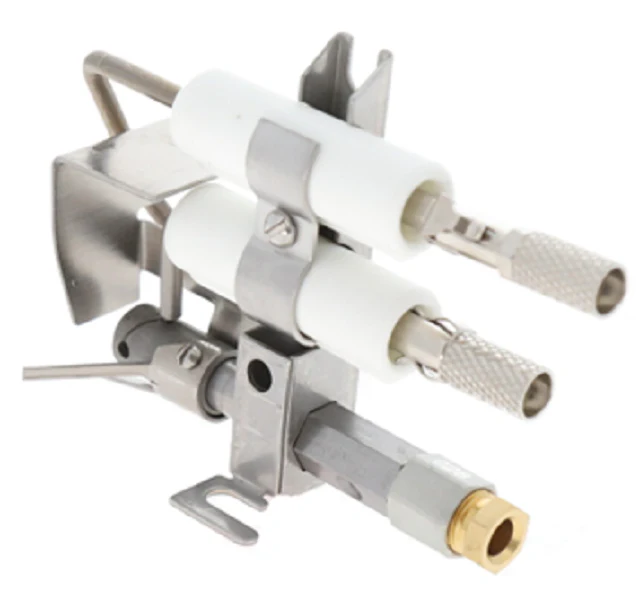
Honeywell Q179A1050 Gas Pilot
The Honeywell Q179A1050 Gas Pilot is a high-performance flame rectifier gas pilot designed for critical integration into residential and commercial heating systems utilizing intermittent or interrupted ignition. As a technician, you know that consistent flame sensing is the backbone of system safety; this unit delivers via a precisely engineered flame electrode and ignition electrode assembly. Featuring a durable T-style port and burner tip with a factory-spec 0.028" diameter orifice, it is calibrated specifically for natural gas applications. The 1/4" compression coupling gas fitting ensures a pressure-tight connection to the pilot line, minimizing leak risks during high-cycle operations. Whether you are performing a Honeywell pilot burner replacement or servicing a complex boiler or furnace, the Q179A1050 (functionally identical to the Honeywell Q179A1050/U) provides the electrical signal stabilization required for modern ignition modules to maintain the main burner circuit without nuisance lockouts.
Key Technical Benefits:
- Enhanced Reliability: The dual-electrode configuration ensures rapid spark-to-pilot ignition and immediate flame rectification for the controller.
- Precise Flow Control: The 0.028" orifice is optimized for stable pilot flame geometry, even in varying manifold pressures.
- Universal Compatibility: Standard 1/4" compression fittings allow for seamless field replacement across multiple HVAC natural gas pilot configurations.
- Robust Construction: Built for high-temperature environments to prevent electrode warping or carbon buildup issues.
Common Service Questions:
Can the Q179A1050 be used with Liquid Propane (LP) systems?
Out of the box, this specific model is configured with a 0.028" orifice for natural gas. For LP applications, an orifice swap tailored to the higher BTU content of propane is required to ensure safe combustion.
What is the difference between the Q179A1050 and the Q179A1050/U?
There is no functional or technical difference between these two model numbers; the "/U" suffix simply denotes a "Universal" retail-packaged version of the same professional-grade Honeywell gas pilot assembly.
How do I troubleshoot a weak flame signal with this pilot?
Ensure the electrode is positioned correctly within the flame envelope to maximize the microamp signal. Check for cracks in the ceramic insulator and verify that the 1/4" compression nut is torqued correctly to prevent pressure drops at the T-style burner tip.
Disclaimer: While we strive for 100% accuracy, product data and specifications are subject to change. Please contact our team to confirm compatibility or technical details before purchasing.
Original: $549.00
-65%$549.00
$192.15Honeywell Q179A1050 Gas Pilot
The Honeywell Q179A1050 Gas Pilot is a high-performance flame rectifier gas pilot designed for critical integration into residential and commercial heating systems utilizing intermittent or interrupted ignition. As a technician, you know that consistent flame sensing is the backbone of system safety; this unit delivers via a precisely engineered flame electrode and ignition electrode assembly. Featuring a durable T-style port and burner tip with a factory-spec 0.028" diameter orifice, it is calibrated specifically for natural gas applications. The 1/4" compression coupling gas fitting ensures a pressure-tight connection to the pilot line, minimizing leak risks during high-cycle operations. Whether you are performing a Honeywell pilot burner replacement or servicing a complex boiler or furnace, the Q179A1050 (functionally identical to the Honeywell Q179A1050/U) provides the electrical signal stabilization required for modern ignition modules to maintain the main burner circuit without nuisance lockouts.
Key Technical Benefits:
- Enhanced Reliability: The dual-electrode configuration ensures rapid spark-to-pilot ignition and immediate flame rectification for the controller.
- Precise Flow Control: The 0.028" orifice is optimized for stable pilot flame geometry, even in varying manifold pressures.
- Universal Compatibility: Standard 1/4" compression fittings allow for seamless field replacement across multiple HVAC natural gas pilot configurations.
- Robust Construction: Built for high-temperature environments to prevent electrode warping or carbon buildup issues.
Common Service Questions:
Can the Q179A1050 be used with Liquid Propane (LP) systems?
Out of the box, this specific model is configured with a 0.028" orifice for natural gas. For LP applications, an orifice swap tailored to the higher BTU content of propane is required to ensure safe combustion.
What is the difference between the Q179A1050 and the Q179A1050/U?
There is no functional or technical difference between these two model numbers; the "/U" suffix simply denotes a "Universal" retail-packaged version of the same professional-grade Honeywell gas pilot assembly.
How do I troubleshoot a weak flame signal with this pilot?
Ensure the electrode is positioned correctly within the flame envelope to maximize the microamp signal. Check for cracks in the ceramic insulator and verify that the 1/4" compression nut is torqued correctly to prevent pressure drops at the T-style burner tip.
Disclaimer: While we strive for 100% accuracy, product data and specifications are subject to change. Please contact our team to confirm compatibility or technical details before purchasing.
Product Information
Product Information
Shipping & Returns
Shipping & Returns
Description
The Honeywell Q179A1050 Gas Pilot is a high-performance flame rectifier gas pilot designed for critical integration into residential and commercial heating systems utilizing intermittent or interrupted ignition. As a technician, you know that consistent flame sensing is the backbone of system safety; this unit delivers via a precisely engineered flame electrode and ignition electrode assembly. Featuring a durable T-style port and burner tip with a factory-spec 0.028" diameter orifice, it is calibrated specifically for natural gas applications. The 1/4" compression coupling gas fitting ensures a pressure-tight connection to the pilot line, minimizing leak risks during high-cycle operations. Whether you are performing a Honeywell pilot burner replacement or servicing a complex boiler or furnace, the Q179A1050 (functionally identical to the Honeywell Q179A1050/U) provides the electrical signal stabilization required for modern ignition modules to maintain the main burner circuit without nuisance lockouts.
Key Technical Benefits:
- Enhanced Reliability: The dual-electrode configuration ensures rapid spark-to-pilot ignition and immediate flame rectification for the controller.
- Precise Flow Control: The 0.028" orifice is optimized for stable pilot flame geometry, even in varying manifold pressures.
- Universal Compatibility: Standard 1/4" compression fittings allow for seamless field replacement across multiple HVAC natural gas pilot configurations.
- Robust Construction: Built for high-temperature environments to prevent electrode warping or carbon buildup issues.
Common Service Questions:
Can the Q179A1050 be used with Liquid Propane (LP) systems?
Out of the box, this specific model is configured with a 0.028" orifice for natural gas. For LP applications, an orifice swap tailored to the higher BTU content of propane is required to ensure safe combustion.
What is the difference between the Q179A1050 and the Q179A1050/U?
There is no functional or technical difference between these two model numbers; the "/U" suffix simply denotes a "Universal" retail-packaged version of the same professional-grade Honeywell gas pilot assembly.
How do I troubleshoot a weak flame signal with this pilot?
Ensure the electrode is positioned correctly within the flame envelope to maximize the microamp signal. Check for cracks in the ceramic insulator and verify that the 1/4" compression nut is torqued correctly to prevent pressure drops at the T-style burner tip.
Disclaimer: While we strive for 100% accuracy, product data and specifications are subject to change. Please contact our team to confirm compatibility or technical details before purchasing.